AquaForge started as a home-scale aquaponics controller and evolved into a real digital twin platform. The core idea was to move from reactive control to predictive operation: detect chemistry drift early, simulate intervention outcomes, and reduce both stress events and wasted inputs.

Stock photo source: Wikimedia Commons.
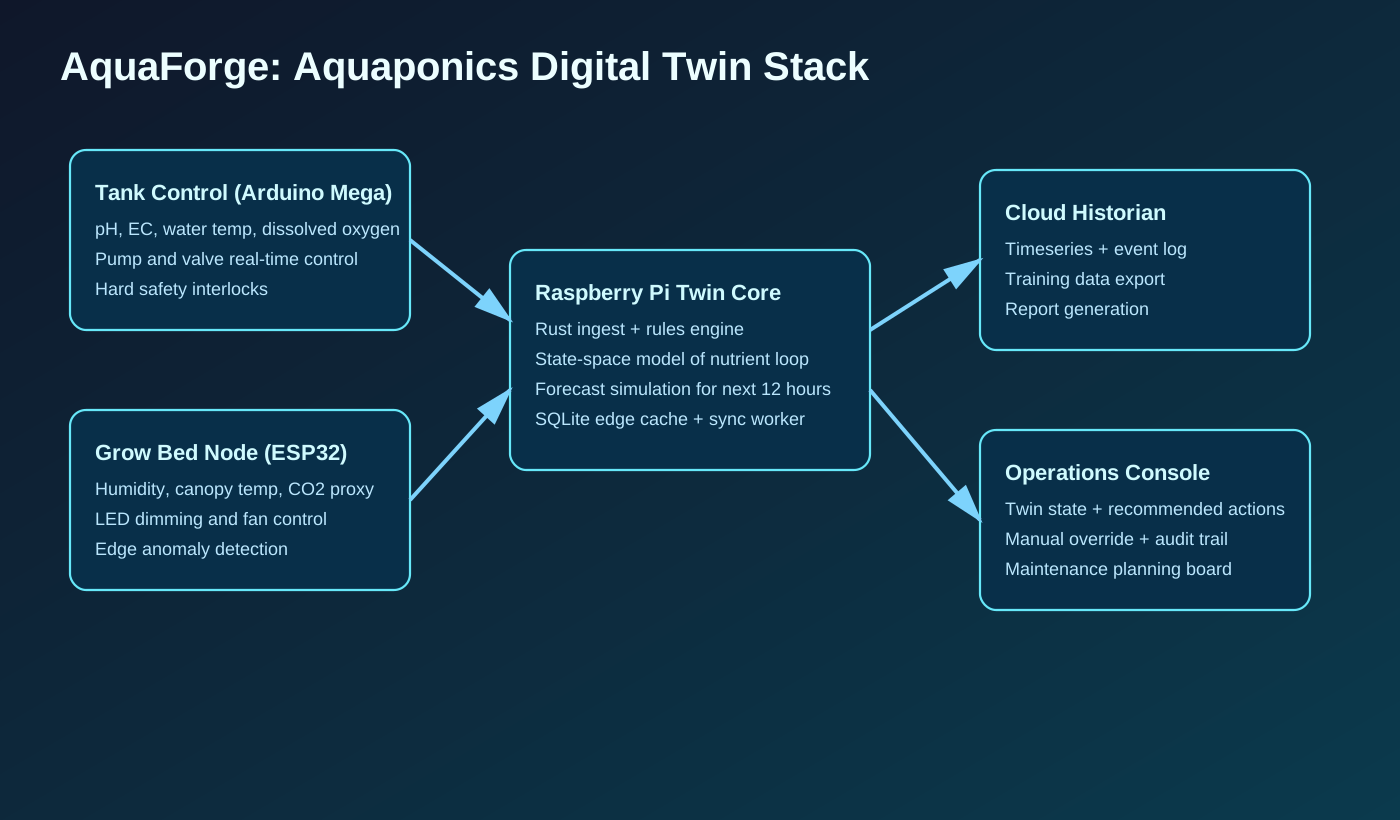
Figure 1: System decomposition of AquaForge with hard real-time control at the edge and model-driven decision support.
Why a digital twin here
Aquaponics has tightly coupled loops:
- fish health,
- water chemistry,
- plant uptake,
- pump and aeration timing.
Small disturbances can cascade. A dashboard with static thresholds is not enough because interactions are time-dependent and nonlinear. The twin was designed to answer “what happens in the next 6-12 hours if we apply action X now?”
Control split and safety design
I used a two-layer control pattern:
- Arduino Mega handled immediate actuator safety and interlocks.
- Raspberry Pi 5 handled higher-level optimization and forecast guidance.
If the Pi failed, the Arduino still kept the system safe with conservative fallback profiles. This separation was non-negotiable.
Sensors and actuators
Key measured signals:
- pH,
- electrical conductivity,
- water temperature,
- dissolved oxygen proxy,
- pump current and flow estimate,
- canopy humidity and temperature.
Controlled outputs:
- circulation pump scheduling,
- aeration duty cycle,
- dosing valve windows,
- grow-light dimming,
- fan control.
Data pipeline and Rust services
The Pi ran Rust services for ingest, validation, state estimation, and recommendation generation. I chose Rust here because low-latency streaming and strict error handling mattered more than rapid prototyping speed.
Core pipeline steps:
- Ingest from Arduino and ESP32 nodes.
- Validate and normalize units.
- Update current state vector.
- Simulate short-horizon scenarios.
- Emit ranked recommendations with confidence.
This ranking step mattered for human adoption. Operators do not want ten options; they want two clear actions with expected impact.
Twin model design
I avoided an overly complex model. The best-performing version used:
- a compact state-space representation,
- empirically tuned transfer coefficients,
- uncertainty bands derived from recent residuals.
The twin continuously compared prediction vs measured outcome and adjusted confidence, not the full structure, in real time. Full retraining happened offline.
Operator UX and trust
Early versions failed one human test: they were technically right but operationally confusing. I changed the recommendation format to include:
- action,
- expected effect size,
- confidence,
- potential side effects,
- fallback plan.
That single change improved acceptance significantly.
Example recommendation object:
{
  "action": "Increase aeration duty from 45% to 60% for 20 min",
  "expected_effect": "DO proxy +0.7 mg/L equivalent",
  "confidence": 0.81,
  "risk_note": "Slight pH rise likely",
  "fallback": "Revert duty if pH > 7.2"
}
Validation and rollout
I ran the rollout in three phases:
- Observe-only (twin predicts, no control changes).
- Assisted mode (operator executes suggestions).
- Semi-automatic mode (low-risk actions auto-applied).
The long observe-only phase was critical for calibrating trust and model drift behavior.
Pilot outcomes
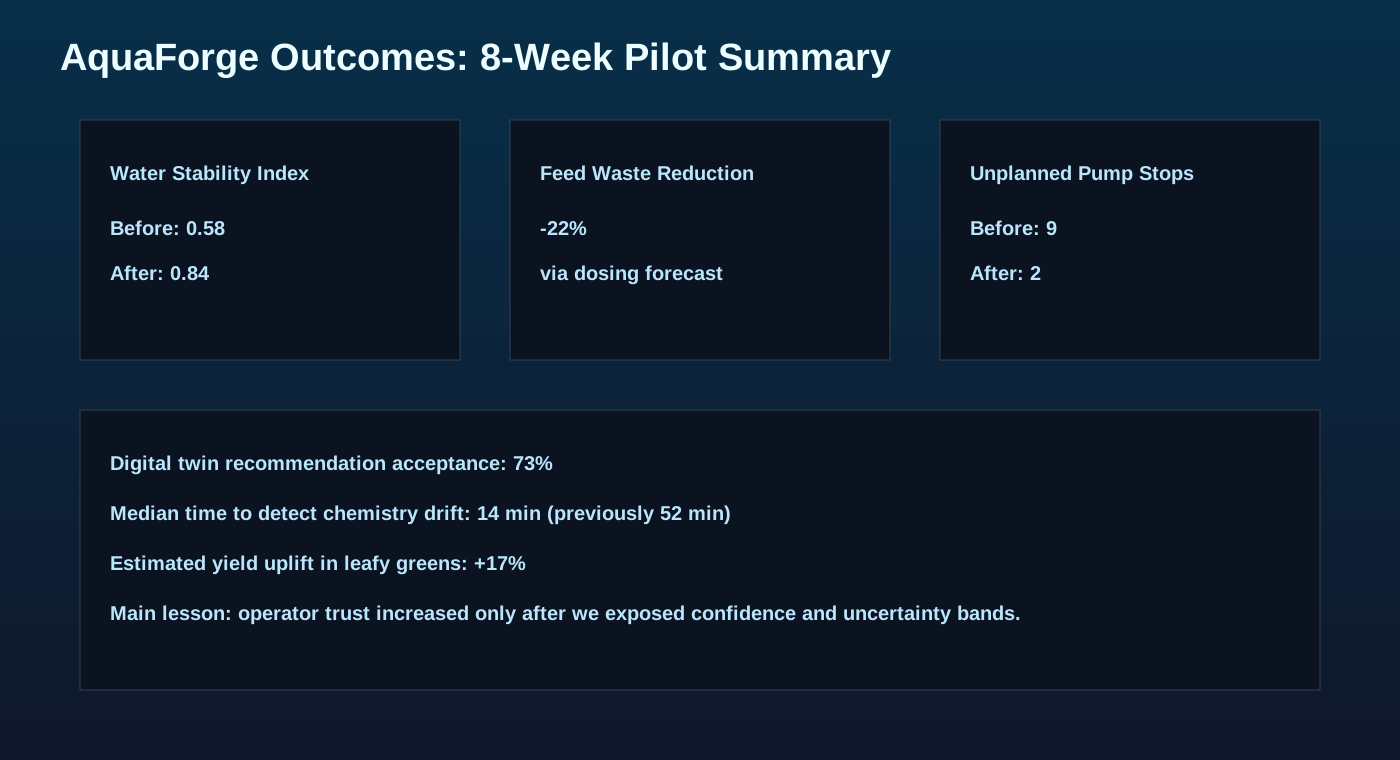
Figure 2: Pilot KPI changes after introducing model-guided control.
Measured 8-week improvements:
- Water stability index: 0.58 -> 0.84.
- Feed waste reduction: 22 percent.
- Unplanned pump interruptions: 9 -> 2.
- Median drift detection latency: 52 minutes -> 14 minutes.
The project also reduced operator fatigue: less manual trial-and-error, fewer panic adjustments.
Failures and fixes
Important failures:
- One dissolved oxygen sensor drifted silently.
- Initial dosing model overfit one warm-week pattern.
- Message burst spikes occasionally delayed recommendation refresh.
Fixes:
- added sensor redundancy checks,
- moved from single-week fit to rolling window constraints,
- introduced bounded queues with priority classes.
Why this stands out
AquaForge is a “special project” because it combines:
- hard safety logic,
- interpretable short-horizon simulation,
- human-centered recommendation design,
- measurable biological and operational gains.
Most hobby systems optimize one layer. This one integrated control, modeling, and workflow into a coherent operating system.
Next technical steps
Planned upgrades:
- explicit nutrient uptake submodel by growth stage,
- small vision module for leaf stress scoring,
- automated calibration planning based on residual drift,
- quarterly model benchmark datasets with reproducibility reports.
For anyone building a similar stack: prioritize deterministic data quality and operator trust long before you optimize model sophistication.