CNCSense was built to solve a common manufacturing pain: legacy machines fail without enough warning, and maintenance teams are forced into reactive firefighting. Replacing whole lines was not an option, so the project goal was retrofit-first predictive maintenance with minimal intrusion.

Stock photo source: Wikimedia Commons.
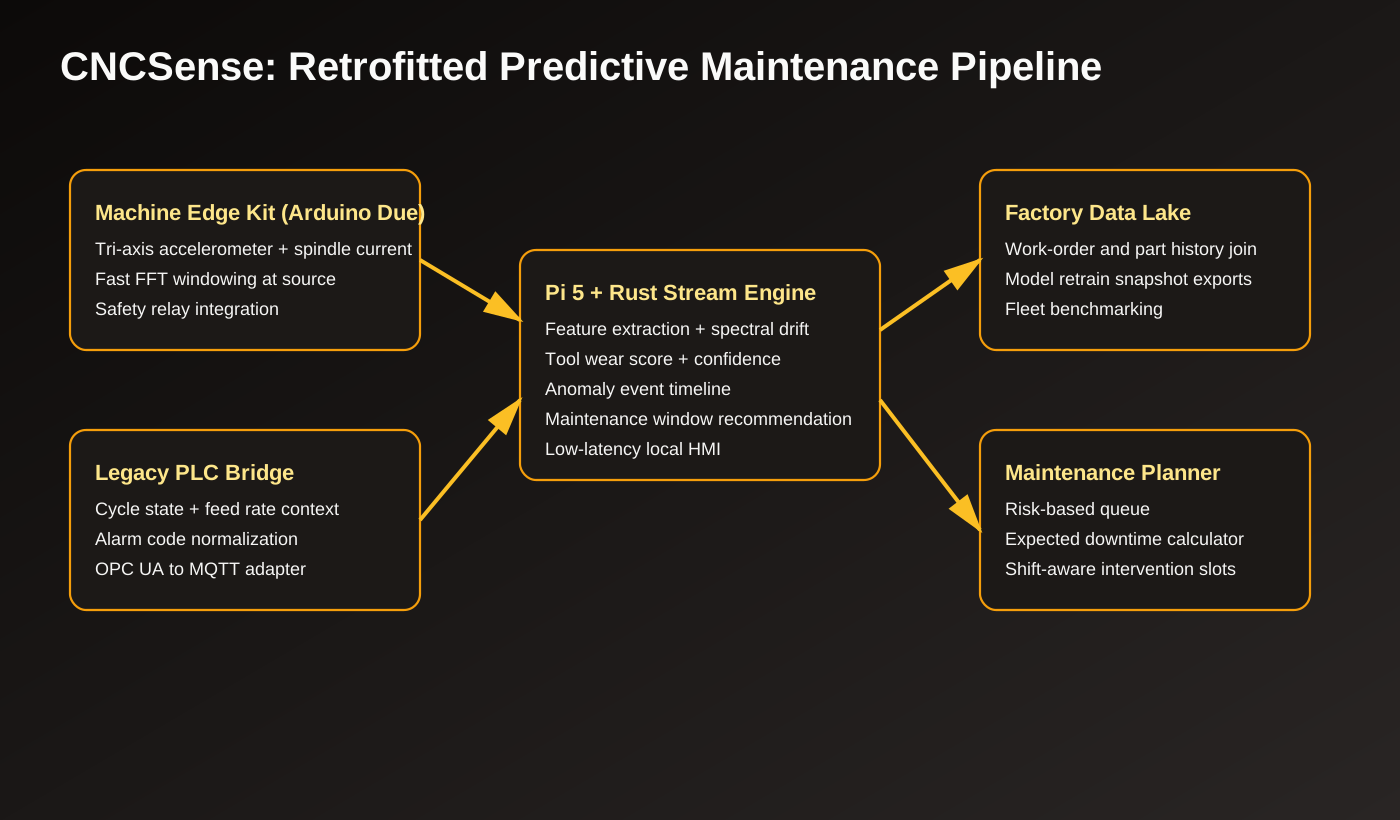
Figure 1: Retrofit topology across machine edge kit, PLC bridge, and Rust analytics hub.
Scope and constraints
The pilot had seven machines across mixed vintages. Constraints were strict:
- no firmware changes on core OEM controllers,
- minimal installation downtime,
- no dependency on permanent cloud connectivity,
- alerts must map to maintenance actions, not abstract anomalies.
Retrofit sensor strategy
I selected a compact edge kit:
- tri-axis vibration sensor,
- spindle current sensing,
- machine cycle-state context from PLC bridge,
- optional acoustic channel for specific machines.
The main design rule was contextualization. Raw vibration amplitude without cycle phase or feed-rate context generated too many false signals.
Edge processing and feature pipeline
Arduino Due handled first-pass signal conditioning and FFT windows. It transmitted compact features to Pi instead of full raw streams whenever possible.
Feature families used:
- spectral centroid drift,
- band energy ratios,
- transient spike density,
- cycle-normalized current deviation.
This reduced uplink load while preserving fault-discriminative information.
Rust decision engine on Pi
The Pi 5 hosted a Rust stream engine with deterministic micro-batches. The decision model combined:
- short-window anomaly score,
- long-window trend score,
- operating context consistency,
- maintenance history priors.
The final output was a tool-wear risk with confidence and an expected lead time before fault threshold.
Alert design for maintenance teams
Early alert versions failed because they were too technical. I changed each alert to include:
- probable component area,
- urgency window,
- confidence,
- supporting feature explanation,
- suggested next inspection step.
This directly increased adoption by technicians.
Example alert payload:
{
  "machine_id": "cnc-04",
  "risk": "HIGH",
  "confidence": 0.86,
  "lead_time_min": 41,
  "suspected_component": "spindle bearing set",
  "evidence": ["high-frequency band drift", "current ripple increase"],
  "recommended_action": "Inspect bearing preload at next micro-stop"
}
Rollout approach
I used a staged rollout:
- Passive observation with no alerts to teams.
- Internal alert validation with maintenance lead.
- Controlled live alerts on two lines.
- Full pilot with weekly calibration review.
This prevented trust collapse from early noisy alarms.
Pilot outcomes
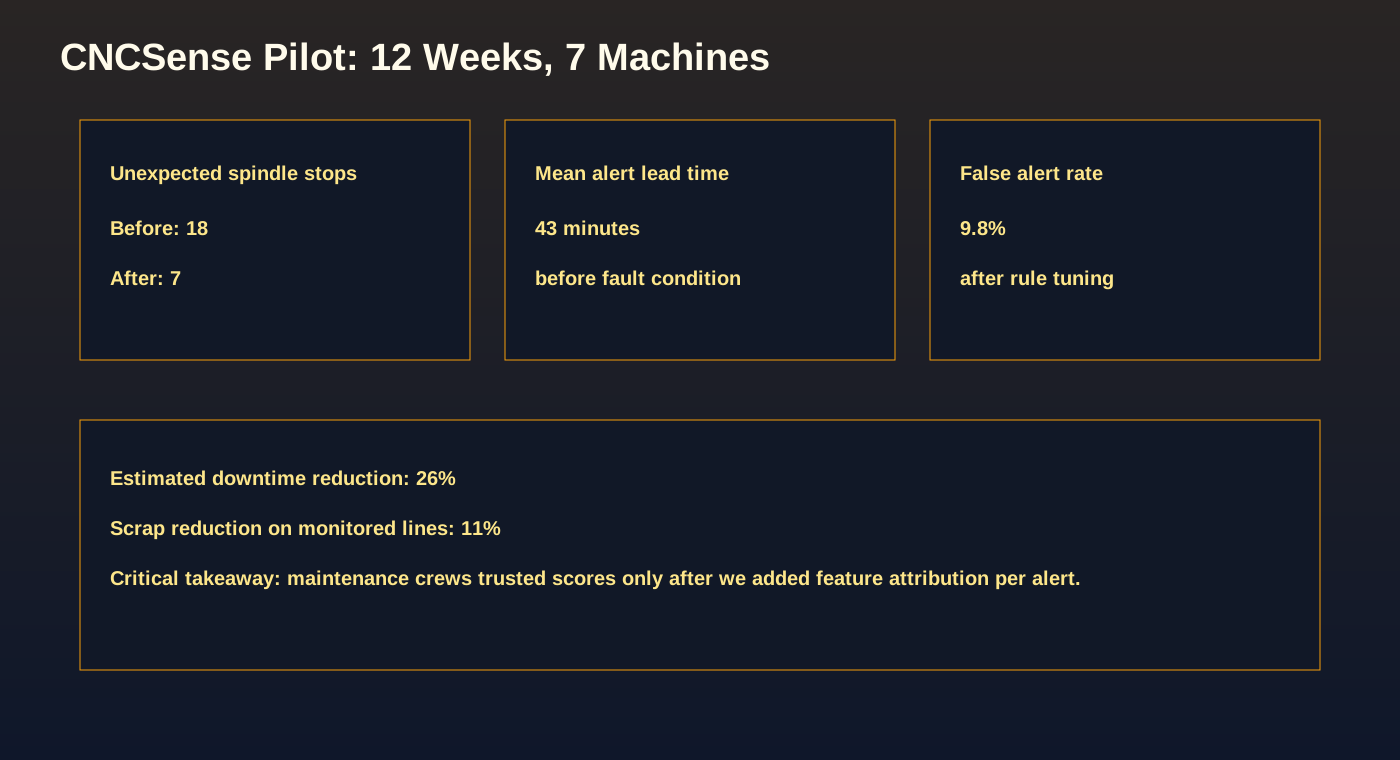
Figure 2: Operational impact from the 12-week retrofit pilot.
Measured effects:
- unexpected spindle stop events: 18 -> 7,
- estimated downtime reduction: 26 percent,
- scrap reduction on monitored lines: 11 percent,
- average actionable lead time: 43 minutes.
False alerts remained under 10 percent after contextual rule tuning.
Failure cases and iteration
Main failure cases:
- alarm storms during atypical heavy-cut jobs,
- sensor mount looseness on one machine,
- edge queue backlog when diagnostic mode was enabled too often.
Resolved with:
- job-class-aware scoring weights,
- mount design revision,
- strict bounded telemetry mode policies.
Why this project is special
CNCSense is special because it delivers measurable reliability gains without replacing legacy equipment. The combination of retrofit hardware, context-rich analytics, and technician-centered alert design made it practical, not just experimental.
Next milestone
Planned next phase:
- cross-machine transfer learning,
- automatic work-order drafting from alerts,
- closed-loop verification between maintenance action and risk decay,
- per-shift confidence drift monitoring.
If you retrofit industrial assets, build around operator workflow and action latency. Predictive models only matter when they create timely, trusted interventions.